

Key Takeaways:
- Ohio ranks third nationally in manufacturing employment, and the sector pays the highest total wages of any industry in the state.
- Six applications produce most of the return: predictive maintenance, visual inspection, production scheduling, demand forecasting, quoting automation, and knowledge capture.
- Most Ohio plants are brownfield sites, so AI has to read from the PLCs, SCADA systems, and historians you already own.
- Budget $25,000 to $60,000 for a single-use-case pilot, $60,000 to $150,000 for multi-line work, and $150,000 to $300,000 or more plant-wide.
- Ohio funding has shifted: MEP support has been suspended since December 2025, while the Ohio Smart Manufacturing Program and NEO-SMART are active.
- Pilots stall on data quality, not on the model. Audit your data before committing a budget.
If you run a plant in Ohio, you have probably been pitched AI at least twice this year. The pitch is rarely wrong. It is just vague, and vague does not survive a capital request.
This guide covers where AI solutions for manufacturing companies in Ohio actually produce a return, what the work costs, how it connects to equipment you already own, and which state funding is genuinely available right now. That last part changed recently, and most articles on this topic have not caught up.
If you are a large plant with an in-house data science team, you do not need this. If you are a twelve-person shop with nothing digital on the floor, AI is premature. Everyone in between should keep reading.
Why Ohio Manufacturers Are Adopting AI Solutions in 2026
Ohio holds roughly 687,000 manufacturing jobs, third in the country. The sector accounts for about 14.4% of all private-sector jobs in the state, with a payroll near $49.9 billion, the highest of any Ohio industry, according to the Ohio Manufacturers’ Association. That is a large base of plants hitting the same wall at the same time.
The hiring problem
Workforce math is the real driver. Deloitte and The Manufacturing Institute project a net need for as many as 3.8 million manufacturing jobs nationally between 2024 and 2033, with roughly 1.9 million potentially going unfilled. In their survey work, 65% of manufacturers named attracting and retaining talent as their biggest business challenge.
Ohio plant managers see this as specific empty seats: CNC machinists, maintenance technicians, welders, industrial electricians. You cannot hire your way out. You can get more out of the people you have.
Margin pressure across sectors
Tariff shifts, volatile input costs, and shorter customer lead times have hit Ohio’s automotive, aerospace, polymer, and metals plants at once. When you cannot raise prices, throughput and scrap become the only levers left.
Money moving into the state
Northeast Ohio won a National Science Foundation Regional Innovation Engines award in July 2026. The NEO-SMART coalition, led by Case Western Reserve University with more than 70 partners, stands to receive up to $160 million over 10 years to build AI, automation, and robotics into the region’s metals, polymers, and coatings base. That funding should widen the pool of smart manufacturing solutions available to Ohio plants over the next few years.
AI Use Cases for Manufacturing Companies in Ohio
Most manufacturing AI use cases that reach production fall into six categories. The rest are research projects wearing a business case, and they rarely move OEE.
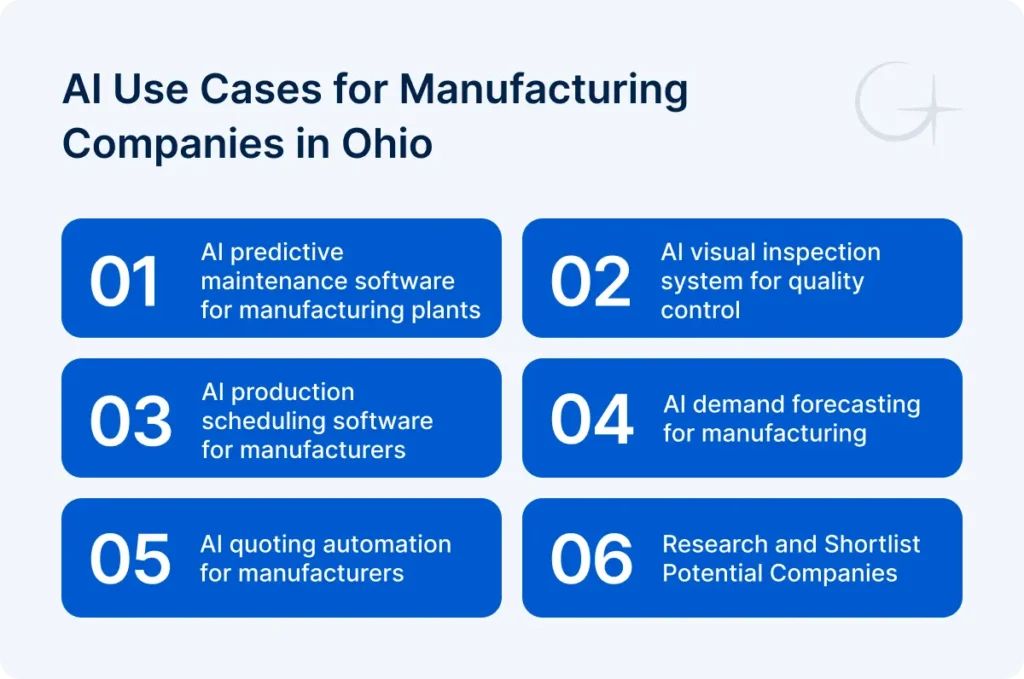
AI predictive maintenance software for manufacturing plants
Models apply time-series anomaly detection to vibration, temperature, current draw, and cycle data from existing sensors, then flag the pattern that precedes a failure. MTBF is usually the first number to move. Instead of a calendar-based PM schedule or a breakdown at 2 a.m., you get a work order with lead time. Best fit for plants running older, high-value assets where one stoppage halts a line.
AI visual inspection system for quality control
Cameras on the line feed a vision model trained on your defect library. It catches surface flaws, dimensional drift, and assembly errors at full line speed without inspector fatigue. Often the fastest use case to prove, because you can benchmark it against current first-pass yield and scrap rate within weeks.
AI production scheduling software for manufacturers
Scheduling in most mid-market plants still lives in a spreadsheet maintained by one person. A scheduling model weighs due dates, changeover time, takt time, material availability, and labor constraints, then re-sequences when a machine goes down or a rush order lands. The gain is recovery speed, not the original plan.
AI demand forecasting for manufacturing
Forecast models combine order history, customer signals, and seasonality to sharpen what you build and what you stock. For contract manufacturers with lumpy demand, better forecasts cut both expedited freight and dead inventory.
AI quoting automation for manufacturers
Quoting eats estimator hours and loses jobs to slow turnaround. A model trained on your historical quotes, routings, and won/lost outcomes can price a standard RFQ in minutes, routing only unusual ones to a human. Job shops feel this immediately.
Knowledge capture from SOPs and maintenance logs
Your most experienced maintenance tech is a single point of failure, and retirement is coming. A language model built over SOPs, equipment manuals, and years of work orders lets a newer technician ask a plain question and get the answer your veteran would have given.
AI Solutions by Manufacturing Sector in Ohio
The same technology pays off differently depending on what you make.
Automotive and EV suppliers
Tier-one and tier-two suppliers around Marysville, Toledo, and Lima face brutal PPM targets and customer audits. AI solutions for automotive suppliers in Ohio usually start with vision inspection and traceability, because a defect that escapes to an OEM costs far more than the inspection system.
Aerospace and defense
Dayton and Cincinnati suppliers work in low volume with heavy documentation burden. AI solutions for aerospace manufacturers in Ohio concentrate on inspection, first-article verification, and pulling searchable answers out of dense compliance records. Data residency matters, so on-premises deployment is often a requirement rather than a preference.
Plastics and polymers
Akron’s polymer cluster runs processes with dozens of interacting variables: melt temperature, cycle time, material lot, ambient humidity. AI solutions for plastics manufacturers in Ohio focus on yield, linking process settings to scrap so operators know which knob actually matters.
Metals and fabrication
Cleveland, Canton, and Youngstown plants run capital-heavy equipment where downtime dominates cost. Predictive maintenance and energy modeling carry the business case, and NEO-SMART’s focus on metals makes this region worth watching.
Precision machining, food processing, and industrial equipment makers apply the same six use cases, usually starting with maintenance or inspection.
Measurable Outcomes Manufacturers Can Expect from AI
Vendors quote large numbers for AI solutions for manufacturers. A note on the ones below: they come from published research across many plants, not from any single Ohio deployment. Use them to size a business case, then validate against your own baseline.
McKinsey’s 2017 research on AI in industrial settings, still among the most cited work on the subject, reports that automated quality testing using image recognition can raise productivity by up to 50%, and that AI-based visual inspection can improve defect detection rates by as much as 90% compared with human inspection.
The same work points to asset productivity gains of up to 20% from combining sensor and maintenance log data, plus forecasting error reductions between 20% and 50%.
Treat those as ceilings reached by mature adopters, not a forecast for your first pilot. A realistic planning assumption for a well-scoped first project is a single-digit to low-double-digit improvement in one metric you already track, within two quarters. At a $50,000 spend, that is still a strong return.
Results depend far more on data quality than on model sophistication. Plants with clean historian data and a defined defect library see results fast. Plants without them spend phase one building that foundation.
How AI Works With Existing Manufacturing Systems
This is where conversations get stuck, and it is the fairest question a plant engineer can ask. AI automation for manufacturing does not replace your controls. It reads from them.
Reading PLC, SCADA, and historian data
Most projects start by pulling tags that already exist. A PLC publishes machine state, SCADA displays it, and a historian may already log it. The job is extracting that data reliably, time-aligning it, and cleaning it. Where sensor coverage is thin, retrofit sensors fill gaps without touching control logic.
Connecting to MES, ERP, and CMMS
Predictions only matter if they land where people work. A maintenance model should write a work order into your CMMS. A scheduling model should push back into your MES or ERP. When AI output lives in a separate dashboard nobody opens, adoption dies quietly. If your stack follows ISA-95 levels, the integration points are usually obvious; if it grew organically, expect discovery work.
Edge versus cloud deployment
Latency-sensitive work such as in-line vision runs on edge computing hardware near the line, so a network hiccup does not stop production. Forecasting can run in the cloud. Defense and aerospace suppliers often require everything on-premises, which is a design decision, not an obstacle.
Work like this sits closer to custom software development than to data science, and it is usually where schedule risk lives.
Custom AI Solutions vs. Off-the-Shelf Manufacturing AI Software
Off-the-shelf platforms are the right answer more often than vendors admit. Custom AI software for manufacturing earns its cost when your process, your legacy systems, or your plant-specific logic fall outside what a packaged product handles. Use this table to decide which side you are on.
| Factor | Off-the-shelf Platform | Custom AI Software |
|---|---|---|
| Best Suited For | Common equipment, standard condition monitoring, vendor data model is acceptable | Unusual processes, legacy system integration, plant-specific logic |
| Time to First Result | Weeks | Two to four months |
| Upfront Cost | Lower, usually subscription-based | Higher, project-based |
| Fit to Your Process | Generic models, limited configuration | Trained on your defect taxonomy, routings, and quoting rules |
| Legacy Integration | Only what the vendor supports | Built to match whatever you run |
| Ownership | Vendor holds the model and often the data | You own the model and training data |
| Ongoing Risk | Price increases, roadmap changes, lock-in | You carry maintenance and retraining |
A middle path works well for most mid-market plants. Buy the platform for the standard 70%, build custom for the 20% that differentiates you, and skip the last 10%.
How AI Implementation Works in a Brownfield Ohio Plant
Most Ohio facilities were built decades ago and upgraded in layers. That is normal, and workable. An AI pilot project for manufacturing sites of that vintage follows a predictable sequence.
Weeks 1 to 2: data readiness audit
Before anyone trains a model, inventory what your systems capture, at what frequency, and how reliably. This step regularly discovers that a historian has been logging a broken sensor for two years. Better to find that now than in month four.
Weeks 3 to 8: single-line pilot
Pick one line, one use case, one metric. Define success numerically before you start: scrap below a specific percentage, or a stated number of downtime hours avoided. Vague success criteria are how pilots become permanent science experiments.
Weeks 9 to 16: validation and rollout decision
Run the model in parallel with current practice, compare against baseline, and train the operators who will use it daily. Then make a straightforward call: scale, adjust, or stop. Stopping is a legitimate outcome and cheaper than pretending.
How Much Do AI Solutions Cost for Manufacturing Companies?
AI implementation cost for manufacturing projects varies more than most vendors admit. Ranges below reflect typical scope for mid-market manufacturers. Your number depends mostly on data readiness and integration complexity, not on the AI itself.
| Level | Cost Range | Timeline | Best Suited For | What It Includes |
|---|---|---|---|---|
| Entry/MVP | $25,000 to $60,000 | 8 to 16 weeks | One plant testing whether AI works on a single problem | One use case, one line, existing data sources. Typical for a vision inspection pilot or predictive maintenance on one critical asset. |
| Mid Level | $60,000 to $150,000 | 4 to 7 months | Plants scaling a proven pilot across lines | Multiple lines or use cases, MES or CMMS integration, retrofit sensors where coverage is thin, operator training, production-grade deployment. |
| Complex Enterprise | $150,000 to $300,000+ | 8 to 18 months | Multi-site operations, regulated or defense supply chains | Plant-wide or multi-site rollout, custom model development, heavy legacy integration, on-premises infrastructure, compliance requirements. |
Two cost drivers sit outside the table. Poor data quality can add four to six weeks before modeling starts, and on-premises deployment raises infrastructure cost but is non-negotiable for many defense suppliers.
To model payback, use a metric you already track. Take the contribution margin you lose in an hour of unplanned downtime, multiply by your annual downtime hours, then apply a conservative 10% to 20% reduction. A plant losing 300 hours a year at $5,000 an hour recovers $150,000 to $300,000 against a $60,000 pilot, which puts the payback period inside the first year. The real question is whether that reduction is achievable in your facility, which is exactly what the pilot exists to answer. The same variables drive software project costs across Ohio: scope, integration depth, and data condition.
Ohio Grants and Incentives for Manufacturing Technology
Verify current status before building any of this into a budget. Ohio’s funding picture shifted over the past year, and much of the advice circulating online is now out of date.
Ohio MEP: currently suspended
This is the important correction. The U.S. Department of Commerce froze Ohio’s Manufacturing Extension Partnership funding in December 2025 pending an Inspector General audit, and the state suspended matching dollars because they are tied to federal funds, as reported by Manufacturing Dive. All six regional centers were affected, including MAGNET in Cleveland and FastLane in Dayton. As of late August 2026, the dispute over audit findings remained unresolved, with bipartisan legislation pending to restore funding. If a consultant tells you to route your AI assessment through Ohio MEP, confirm the program is operating first.
Ohio Smart Manufacturing Program
This one is active. In August 2026, Bullen Ultrasonics in Eaton received a grant through the program to apply machine learning and digital twin modeling to process improvement, analyzing roughly two billion data points from its equipment. The award was $23,100, which is worth knowing: these grants offset project costs; they do not fund them outright.
JobsOhio and NEO-SMART
JobsOhio runs several programs touching advanced manufacturing, including its R&D Center Grant and the 166 Direct Loan for projects improving operational efficiency. Northeast Ohio manufacturers should track NEO-SMART as its programs come online.
How to Choose an AI Development Company for Manufacturing
The criteria that matter are not the ones most vendors lead with. Take these eight questions into your next vendor call.
1. Have you integrated with OT systems before? Make them describe the specific handoff between PLC or historian data and their model. Vague answers here predict schedule overruns.
2. Can you deploy on-premises? The answer is binary, and you will need it if you serve defense or aerospace customers.
3. Who owns the model and the training data when the contract ends? Get this in writing before work starts, not during renewal.
4. What happens after go-live? A proof of concept is not a system. Ask about monitoring, retraining as your process drifts, and support when a model behaves oddly at 3 a.m.
5. How do you handle bad or missing data? Every brownfield plant has some. The answer tells you whether they have worked in a real facility.
6. What does your team need from my staff, and for how many hours? Hidden internal time is the most commonly underestimated project cost.
7. Which metric will we measure, and what counts as failure? A partner unwilling to define failure is not planning to be measured.
8. When is AI the wrong answer? Anyone who has never talked a client out of a project is selling, not advising. Plenty of plant problems are solved better by a $4,000 sensor and a rule.
Why Choose Gleaming Systems for Manufacturing AI Solutions
We are based in Lewis Center, just north of Columbus, and we work through an onshore model where the people gathering your requirements and delivering the project are in the United States. Our AI and ML integration practice in Columbus handles the integration-heavy work manufacturing AI actually requires.
We will be straightforward about our track record: our closest work is adjacent rather than in-plant. We built a quality deficiency management system handling inspection workflows, defect capture, and reporting dashboards, and a defense equipment asset tracking platform managing complex asset data and configuration. Both share the fundamentals of plant-floor AI: messy operational data, integration with existing systems, and users who abandon anything that slows them down.
If you want to test whether a use case fits your facility, a conversation about your current data and one target metric is a reasonable place to start.
FAQs: AI Solutions for Manufacturing Companies in Ohio
How much does AI implementation cost for a mid-sized Ohio manufacturer?
A single-use-case pilot typically runs $25,000 to $60,000. Multi-line deployments with MES or CMMS integration fall between $60,000 and $150,000. Plant-wide programs with custom model development start around $150,000 and rise with integration complexity.
How long does an AI pilot take in a manufacturing plant?
Plan on roughly 16 weeks: two weeks auditing data readiness, six weeks building and testing on one line, and eight weeks of parallel validation, operator training, and a scale-or-stop decision. Plants with poor data quality should add four to six weeks.
Can AI work with older equipment that has no modern controls?
Usually, yes. Retrofit sensors capture vibration, temperature, and current draw on machines with no native data output, feeding a model without altering control logic. Budget for that instrumentation from the start.
Is Ohio MEP still available for manufacturing technology projects?
Federal funding was frozen in December 2025 pending an audit, and state matching funds were suspended alongside it. As of late 2026, the situation remains unresolved. Confirm with the Ohio Department of Development before relying on MEP support in a project plan.
Which AI use case should a manufacturer start with?
Start with whichever metric you already measure reliably and lose the most money on. For most Ohio manufacturers, that is unplanned downtime or scrap, pointing to predictive maintenance or visual inspection. Both have clear baselines, which makes results easy to verify.

Team Gleaming Systems
Team Gleaming Systems is a group of tech experts specializing in software, web, and mobile app development. We create innovative, scalable solutions to help businesses succeed in the digital world. Stay tuned for expert insights and industry trends!