

Key Takeaways:
- AI predictive maintenance for manufacturing uses sensor and machine data to spot equipment problems days or weeks before they cause a breakdown.
- Older equipment is not a dealbreaker. Retrofit sensors, edge gateways, and existing PLC data can bring legacy machines into a predictive program.
- Costs typically range from $25,000 to $300,000+, depending on the number of assets, integrations, and whether you start with a pilot or a plant-wide rollout.
- ROI comes mainly from avoided downtime, followed by lower maintenance labor, reduced emergency parts spending, and longer asset life.
- Start with a focused pilot on a few critical assets, prove the value, then scale across lines and facilities.
A bearing starts running hot on a Tuesday. Nobody notices. By Thursday, the line is down, a customer shipment is late, and your maintenance crew is pulling overtime to fix something that gave off warning signs for days.
That is the problem AI predictive maintenance for manufacturing solves. It learns what normal looks like for each machine and flags early signs of failure while there is still time to plan a repair.
The stakes are high in Ohio, which ranks third nationally in manufacturing employment with 687,345 jobs, according to the Ohio Manufacturers’ Association. Three pressures make downtime harder to absorb:
- Downtime is getting more expensive. Siemens’ True Cost of Downtime 2024 report found that unplanned downtime costs the world’s 500 largest companies about $1.4 trillion a year, or 11% of revenue. In large automotive plants, a stopped line can cost up to $2.3 million per hour.
- Experienced maintenance talent is hard to find. The OMA’s Manufacturing Workforce Blueprint projects more than 35,000 annual job openings for technicians and operators in Ohio. When senior technicians retire, their instincts leave with them.
- OEM customers expect on-time delivery. Tier 1 and Tier 2 suppliers serving automotive and aerospace programs have little room for missed shipments.
Below, you’ll see how predictive maintenance works, where it pays off in Ohio’s core industries, what it costs, how to calculate ROI, and how to roll it out one phase at a time.
How AI-Powered Predictive Maintenance Works in Manufacturing
AI-powered predictive maintenance collects real-time data from your machines, compares it against learned patterns of healthy operation, and alerts your team when something starts drifting toward failure. The goal is simple: fix equipment based on its actual condition, not on a calendar or after it breaks.
Here is how it compares with the maintenance approaches most plants already use:
| Approach | When Work Happens | Main Drawback | Data Needed |
|---|---|---|---|
| Reactive | After a failure | Costly unplanned downtime and emergency repairs | Almost none |
| Preventive | On a fixed schedule | Parts replaced too early, and random failures still occur | Runtime hours or calendar dates |
| Predictive | When condition data shows a developing fault | Requires sensors, data infrastructure, and upfront investment | Continuous machine and sensor data |
The U.S. Department of Energy’s O&M Best Practices Guide estimates that a well-run predictive maintenance program saves 8% to 12% over preventive maintenance alone. Facilities that still rely heavily on reactive maintenance may find savings opportunities above 30% to 40%.
Data Collection
IIoT sensors capture vibration, temperature, pressure, acoustic signals, and motor current. Your existing PLCs, SCADA systems, and data historians add operating context such as cycle counts, speeds, and load. CMMS work order history then tells the system which past patterns actually led to failures.
Condition Monitoring and Vibration Analysis
Condition monitoring tracks equipment health in real time. Vibration analysis is often the most valuable signal for rotating equipment, because bearing wear, misalignment, and imbalance each leave a distinct vibration signature long before a machine seizes.
Machine Learning Models
This is where AI adds value beyond traditional threshold alarms. Machine learning predictive maintenance models use anomaly detection to catch unusual behavior, even if no fixed limit has been crossed. Failure prediction models go further by recognizing patterns that preceded past breakdowns.
A good model reduces false alarms, which matters more than most vendors admit. If technicians get flooded with alerts that lead nowhere, they stop trusting the system.
Remaining Useful Life Estimation
Remaining useful life (RUL) estimates how long a component can keep running before it needs attention. Your planner sees “roughly three weeks left” instead of a vague warning, so repairs can be scheduled and parts ordered ahead of time.
Edge Computing, Alerts, and Digital Twins
Mature systems push alerts to mobile devices, create CMMS work orders automatically, and feed OEE dashboards. Edge computing handles fast, local processing near the machine, while the cloud handles model training. Some plants add a digital twin, a virtual model of an asset, to test scenarios safely.
Predictive Maintenance Use Cases for Ohio Manufacturers
Predictive maintenance for manufacturing companies looks different depending on what you produce. The most effective predictive maintenance for Ohio manufacturers starts with the machines behind each sector’s costliest failures. It is also one of several AI solutions for manufacturing companies in Ohio, alongside visual inspection and production scheduling.
Automotive and Auto Parts
Suppliers across the Toledo and central Ohio corridors run stamping presses, robotic welding cells, and CNC machining centers on tight just-in-time schedules. Useful signals include press clutch and brake performance, servo motor current on robots, and spindle vibration on CNC machines. Tracking them helps catch issues before they stop a line feeding an OEM.
Plastics and Polymer Processing
The Akron region’s polymer processors depend heavily on injection molding machines and extruders. Hydraulic pump degradation, heater band failures, and screw and barrel wear are common culprits. A slowly failing machine often produces scrap before it fully stops.
Metal Fabrication and Primary Metals
Metal operations in Cleveland, Youngstown, and surrounding areas rely on rolling mills, furnaces, large motors, and air compressors. Bearing monitoring on mills and thermal monitoring on furnaces help prevent failures that can take days to recover from. The same approach works for industrial machinery builders, where hydraulic systems and gearboxes are frequent failure points.
Aerospace and Defense Components
Dayton-area component manufacturers machine high-value parts to tight tolerances. A deteriorating spindle can quietly push parts out of spec, turning expensive materials like titanium into scrap. Predictive monitoring protects quality as much as uptime.
Food and Beverage Processing
Plants in the Cincinnati region and beyond run conveyors, packaging lines, and refrigeration systems around the clock. A refrigeration compressor failure can put entire batches of product at risk. Monitoring also helps teams plan repairs around sanitation windows.
Can AI Predictive Maintenance Work With Legacy Equipment?
Yes. Predictive maintenance for legacy equipment is often where the biggest gains are. Older machines tend to fail more often, and they usually have the least visibility.
Retrofit IIoT Sensors
Wireless vibration, temperature, and current sensors can be mounted on machines that are decades old, usually with magnetic or adhesive mounts. Installation rarely requires modifying the equipment, and it can often be scheduled during planned downtime.
Existing PLC and SCADA Data
Many Ohio plants already have more data than they realize. PLCs, SCADA systems, and historians hold years of operating data. With industrial protocols such as OPC UA or Modbus, that data can be pulled into a predictive model without replacing controls.
Edge Gateways
Edge gateways connect older equipment that speaks outdated protocols or has no network connection at all. They collect, translate, and pre-process data locally, then pass it to your analytics platform securely.
Machine age matters less than whether your critical failures give off measurable signals. For most rotating, hydraulic, and thermal equipment, they do.
Off-the-Shelf vs. Custom Predictive Maintenance Software
Both types of AI predictive maintenance solutions can work. The right choice depends on how standardized your equipment is and how complex your systems are.
| Factor | Off-the-Shelf Platform | Custom Solution |
|---|---|---|
| Time to Launch | Faster for common assets | Longer upfront build |
| Equipment Coverage | Best for standard machines | Handles mixed and legacy fleets |
| Integration | Limited to prebuilt connectors | Built around your CMMS, ERP, and MES |
| Data Ownership | Often stored on vendor platforms | You control data and models |
| Long-Term Cost | Recurring per-asset or per-user fees | Higher initial cost, fewer recurring license fees |
When Off-the-Shelf Makes Sense
If your plant runs mostly standard motors, pumps, and compressors, and your CMMS is a popular platform with ready-made connectors, an off-the-shelf tool can get you started quickly. The trade-off tends to appear later, when your equipment mix grows, or the platform’s connectors don’t fit your systems.
When Custom Makes Sense
Custom predictive maintenance software development is the better fit when you run a mix of equipment brands and ages, rely on proprietary processes, or need predictions to flow into a homegrown ERP or MES. Custom systems also make sense when per-asset licensing costs would climb steeply as you scale across multiple facilities.
How Much Does AI Predictive Maintenance Software Cost?
AI predictive maintenance software typically costs between $25,000 and $300,000+. Where your project lands depends mostly on scope: how many assets you monitor, how advanced the models are, and how many systems the solution connects to.
Cost by Project Scope
| Project Scope | Indicative Cost | What It Typically Includes |
|---|---|---|
| Pilot/Proof of Concept | $25,000 to $60,000 | 3 to 10 critical assets on one line, retrofit sensors, anomaly detection, a basic dashboard, and limited integration |
| Mid-Tier System | $60,000 to $150,000 | One or more production lines, failure prediction models, CMMS integration, and mobile alerts |
| Enterprise Platform | $150,000 to $300,000+ | Plant-wide or multi-site coverage, remaining useful life models, CMMS, ERP, and MES integration, edge infrastructure, and role-based access |
A pilot is the practical starting point for most plants. It exposes data gaps early, when they are cheaper to fix, and produces real numbers to justify the next phase.
Main Cost Factors
- Number and type of assets: Monitoring 10 motors costs far less than monitoring an entire press line.
- Sensors and hardware: Retrofit sensors and edge gateways add cost, while existing PLC data can reduce it.
- Integrations: Connecting to CMMS, ERP, MES, and SCADA systems is often the largest variable.
- Model complexity: Simple anomaly detection costs less than failure-specific models with RUL estimation.
- Data readiness: Clean, labeled failure history speeds up development. Scattered or missing records add work.
Ongoing Costs
Budget for cloud hosting, sensor maintenance, periodic model retraining, and software maintenance and support. Models need retraining when you add equipment or change processes. The sample ROI calculation below assumes $30,000 per year for these costs.
How to Calculate Predictive Maintenance ROI
Predictive maintenance ROI for manufacturers comes down to one comparison: what unplanned downtime and reactive repairs cost you today versus what the system costs to build and run.
ROI Formula
Annual savings = (Downtime hours avoided × Cost per downtime hour) + Maintenance labor savings + Emergency parts savings + Value of extended asset life
ROI = (Annual savings − Annual system cost) ÷ Total investment × 100
Cost per downtime hour should include lost production, idle labor, scrap, expedited shipping, overtime, and any customer penalties.
Sample Calculation
Consider a hypothetical mid-sized Ohio plant. The figures below are illustrative assumptions, so replace them with your own numbers.
- Unplanned downtime on critical assets: 60 hours per year
- Cost per downtime hour: $10,000
- Downtime avoided with predictive maintenance: 25%, or 15 hours
- Downtime savings: $150,000
- Reduced overtime and emergency parts: $40,000
- Total annual savings: $190,000
Against an initial investment of $120,000, which falls in the mid-tier range, and ongoing costs of $30,000 per year, net annual savings come to $160,000. That puts payback at roughly nine months, with an annual ROI of about 133% on the initial investment. Payback is fastest on bottleneck machines, assets with long repair lead times, and lines feeding OEM customers.
How to Implement AI Predictive Maintenance in an Ohio Manufacturing Plant
A phased rollout keeps risk low and builds trust with your maintenance team. These predictive maintenance implementation steps work for most mid-sized plants.
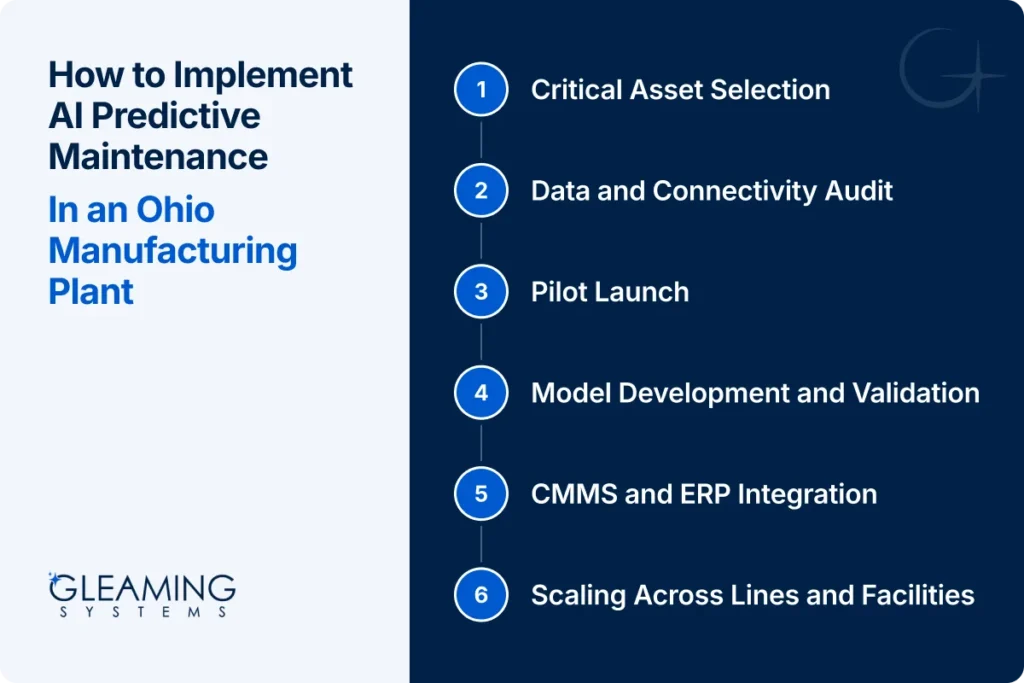
Step 1: Critical Asset Selection
Rank equipment by downtime cost, failure frequency, and repair lead time. Pick 3 to 10 assets for the pilot. Review past work orders to identify the failure modes you want to predict.
Step 2: Data and Connectivity Audit
Map what data already exists in your PLCs, SCADA, historian, and CMMS. Identify where sensors are missing and whether your plant network can reach those machines. Involve IT/OT early, since security and network access decisions can slow a project if they surface late.
Step 3: Pilot Launch
Define success metrics first, such as detected faults, avoided downtime hours, or reduced emergency work orders. Then install sensors and connect data sources for the pilot assets.
Step 4: Model Development and Validation
Build and train machine learning models on historical and live data. Validate predictions with your maintenance technicians. Their feedback on real versus false alerts is essential for tuning accuracy.
Step 5: CMMS and ERP Integration
Integrate predictive maintenance with your CMMS so alerts generate work orders automatically. Connect to ERP for parts availability and purchasing. Without this step, predictions stay on a dashboard nobody checks.
Step 6: Scaling Across Lines and Facilities
Once the pilot meets its success metrics, expand in phases: similar assets on the same line first, then other lines, then other facilities. Reuse the sensor setup, data pipelines, and models proven in the pilot so each phase moves faster than the last. Keep alert rules and reporting consistent across sites, so maintenance leaders can compare asset health and OEE plant to plant.
How to Choose the Right AI Development Partner
The right partner understands both machine learning and the realities of a plant floor. Use these criteria whether you are evaluating a manufacturing AI company in Ohio, an AI software development company in Ohio, or a national provider.
Manufacturing and OT Experience
Ask whether they have pulled data from PLCs and SCADA and integrated it with CMMS, ERP, or MES platforms. AI skills alone are not enough.
Machine Learning Depth
Look for experience building custom AI models for anomaly detection and time-series forecasting, not just dashboards on top of generic analytics.
Security Practices
Ask how they handled network segmentation, access controls, and data storage on past projects, and request documentation. Also confirm who owns the data and trained models once the project ends.
Pilot-First Approach and Support
Be cautious of partners who push a plant-wide rollout from day one. A good partner recommends a measurable pilot, then stays involved for model retraining and support after launch.
Frequently Asked Questions
How long does it take to implement AI predictive maintenance?
A focused pilot usually takes about two to four months, depending on data readiness, sensor installation, and integration needs.
How much historical data is needed for machine learning predictive maintenance?
Several months of operating data is a practical starting point for anomaly detection. Failure-specific models work best with records of past breakdowns, but you do not need years of perfect data to begin. Models improve as they collect more live data.
Can predictive maintenance software integrate with an existing CMMS or ERP?
Yes. Most modern CMMS and ERP platforms offer APIs that support automated work orders, parts requests, and asset history syncing.
What is the difference between predictive maintenance and condition monitoring?
Condition monitoring tells you the current health of an asset. Predictive maintenance uses that data, along with machine learning, to forecast when a failure is likely and what action to take.
Is AI predictive maintenance secure?
It can be, when designed properly. Secure systems keep OT networks segmented from business IT, encrypt data in transit, and use role-based access. Sensitive data can also be processed at the edge, so raw production data doesn’t have to leave the plant.
Is predictive maintenance software available for manufacturers in Cleveland, Columbus, and Cincinnati?
Yes. Manufacturers in Cleveland, Columbus, Cincinnati, Dayton, Toledo, Akron, and Youngstown can deploy it. Most predictive maintenance software projects in Ohio combine remote development and monitoring with on-site sensor installation and integration testing. When comparing industrial AI solutions in Ohio, ask how each provider splits remote and on-site work.
Final Note: Reduce Unplanned Downtime with AI Predictive Maintenance
Unplanned downtime rarely comes without warning. The signals show up in vibration, temperature, and operating data. AI predictive maintenance for manufacturing helps your team act on them before production stops.
At Gleaming Systems, we build custom AI and software solutions around how manufacturers actually operate. In one project for a hard chrome manufacturer, we delivered a Manufacturing Execution System, a staff iOS app, and an integrated operations platform with issue tracking, smart notifications, and a stage history board. The results included a 75% improvement in real-time production visibility across departments, a 60% reduction in average production delay, and 80% of issues logged and resolved faster through priority tagging and built-in chat.
That kind of shop-floor visibility is the foundation predictive maintenance builds on. If you are weighing where to start, our AI/ML integration team in Columbus, Ohio, is happy to talk through your critical assets, existing data, and what a sensible pilot could look like for your plant.

Team Gleaming Systems
Team Gleaming Systems is a group of tech experts specializing in software, web, and mobile app development. We create innovative, scalable solutions to help businesses succeed in the digital world. Stay tuned for expert insights and industry trends!