
Your biggest customer pulls a release forward three weeks. Your planner rebuilds the forecast in Excel, purchasing scrambles for material, and the plant runs overtime to catch up. A month later, the same customer cuts volume, and the extra stock sits in the warehouse tying up cash.
That cycle is why more mid-sized plants are evaluating AI demand forecasting in manufacturing, and Ohio feels it sharply. The state ranks third in the nation for manufacturing jobs, and close to 40% of those workers are at mid-sized facilities with 100-499 employees, according to the Ohio Manufacturers’ Association. These are the companies that have outgrown spreadsheets but don’t have a data science team.
This guide is for operations, supply chain, and finance leaders who are past the “should we?” stage and are comparing demand forecasting software for mid-sized manufacturers. It covers use cases, data needs, costs, and rollout.
What Is AI Demand Forecasting for Manufacturing?
AI demand forecasting uses machine learning to predict what customers will order, how much, and when. It learns from far more data than a planner can track by hand.
Traditional methods, like moving averages or basic time-series forecasting built on last year’s numbers, assume the future will look like the past. Machine learning demand forecasting in manufacturing looks for relationships instead. How do a customer’s EDI releases compare to what they actually pull? How do resin prices affect order timing? How does seasonality differ by SKU? The model tracks these patterns across thousands of items at once and updates as new data arrives.
For planners, the output is practical:
- SKU-level forecasts by week or month, with a confidence range
- Exception alerts when demand moves away from plan
- Suggested purchase and production quantities that feed into MRP
Forecasting works best as one piece of a broader AI integration plan, connected to the systems your team already uses.
How AI Demand Forecasting Helps Ohio Manufacturers
For Ohio plants, the payoff of AI demand forecasting in manufacturing is better decisions about inventory, purchasing, and production. McKinsey’s research found that AI-driven forecasting in supply chain management can reduce forecast errors by 20 to 50 percent, with lost sales and product unavailability falling by up to 65 percent. Results depend on data quality and product mix.
Lower Excess Inventory
Cutting excess inventory is the most direct way to reduce inventory costs with AI forecasting. Better forecasts let you carry less safety stock without raising stockout risk. For the CFO, that means working capital freed up from the warehouse floor.
Fewer Stockouts and Expedites
When the model flags a demand spike early, purchasing can order at normal lead times. Premium freight and weekend shifts become the exception again.
Steadier Production Schedules
Fewer last-minute changes to production scheduling matter when skilled labor is hard to find. Deloitte and The Manufacturing Institute project that up to 1.9 million U.S. manufacturing jobs could go unfilled through 2033. Planning around the crew you actually have is now a real advantage.
Smaller Bullwhip Effect
Models trained on actual consumption as well as order history can separate real demand from customer overreaction. Small swings stop snowballing through your supply chain.
Supply Chain Visibility Across Sites
If you run more than one plant or warehouse, one model can forecast across locations and show where stock should sit. If inventory visibility is still a struggle, our article on why Ohio businesses are moving to cloud-based inventory systems covers that groundwork.
AI Demand Forecasting Use Cases for Ohio Manufacturers
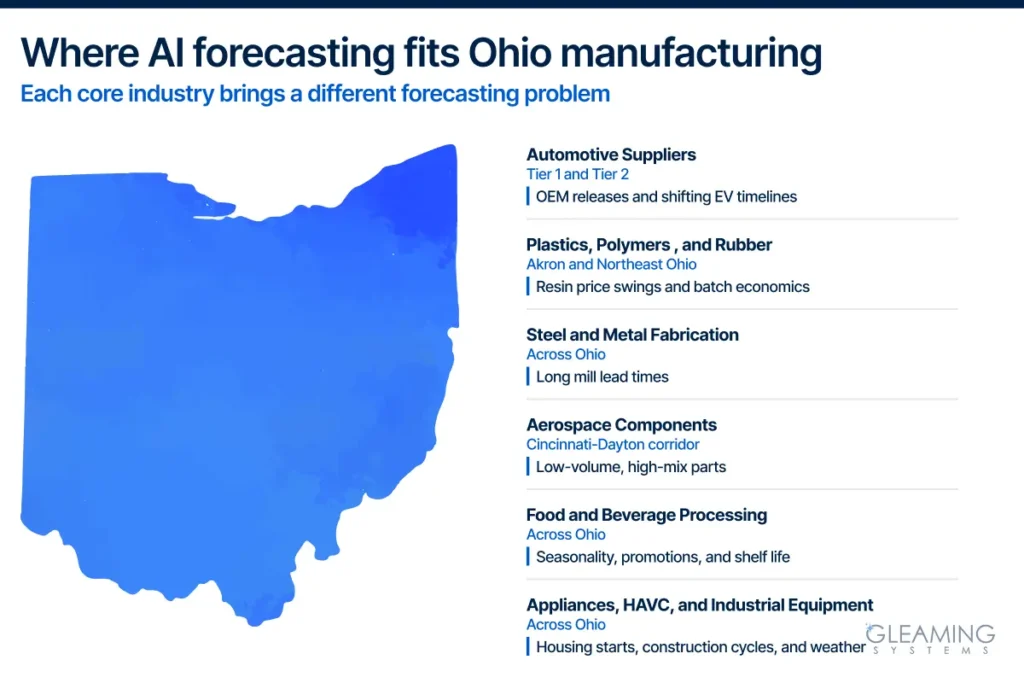
Each of Ohio’s core industries has a different forecasting problem, which is why predictive analytics for manufacturing in Ohio rarely works as a single generic model.
Automotive Suppliers
Tier 1 and Tier 2 suppliers get OEM releases that change weekly, while EV program timelines keep moving. AI forecasting for automotive suppliers compares release history against actual pulls to estimate how much of each release will hold. Your team builds to what’s likely to ship.
Plastics, Polymers, and Rubber
Processors around Akron and Northeast Ohio juggle resin price swings and batch economics. Forecasts that include commodity price signals help purchasing time buys and help schedulers plan runs with manageable changeovers.
Steel and Metal Fabrication
Long mill lead times force you to commit to material well before orders firm up. Forecasting by product family and customer segment gives buyers a defensible basis for those commitments.
Aerospace Components
Shops in the Cincinnati-Dayton corridor handle low-volume, high-mix parts with long program horizons. With thin data per part, forecasting at the program or part-family level works better.
Food and Beverage Processing
Seasonality, promotions, and shelf life leave little room for error. Forecasts that factor in retailer promotions and weather can reduce both spoilage and short shipments. Many of the same techniques apply on the distribution side, as we explained in our piece on AI integration for logistics companies.
Appliances, HVAC, and Industrial Equipment
Demand here follows housing starts, construction cycles, and weather. External signals carry more weight in this segment than almost anywhere else.
What Data and Systems Does AI Demand Forecasting Need?
Most manufacturers already have the core data. It’s just scattered across systems, and fixing that is most of the work.
Core Data Sources
Two to three years of order and shipment history is a solid starting point. Add inventory levels, open purchase orders, production history, supplier lead times, and customer master data.
External Demand Signals
Commodity prices, customer EDI forecasts, economic indicators, and weather can all improve accuracy, but only if they actually relate to your demand. Test each signal on its own rather than adding everything.
ERP and MRP Integration
Here’s how teams typically integrate AI forecasting with an ERP:
- Extract: Data comes from your ERP/MRP (Epicor, Plex, Infor, SAP Business One, JobBOSS, or a custom system), plus sales, inventory, and production records.
- Prepare: A data pipeline cleans, matches, and combines it.
- Forecast: The model generates predictions and confidence ranges.
- Act: Forecasts flow back into the ERP or a planning dashboard, where planners review, adjust, and approve them.
Integration is usually the hardest part. Older ERP versions may have limited APIs, heavy customization, or years of inconsistent part numbers. That’s why it pays to work with an AI/ML integration company in Columbus, Ohio, or another partner who understands both the data and how planners work day to day.
Imperfect Data
Clean data is rare, and that’s normal. Duplicate SKUs, missing lead times, and spreadsheet overrides get sorted out during the data audit. Warehouse data matters too. If stock locations and movements live in a separate system, our guide to custom WMS development explains how to structure that data so planning tools can use it.
How Much Does AI Demand Forecasting Cost in Ohio (and What’s the ROI)?
For most Ohio manufacturing plants, a custom build puts the cost of AI demand forecasting software between $20,000 and $300,000+. Scope drives that price. A partner near your plant in Cleveland, Columbus, Toledo, or Cincinnati mainly helps with on-site discovery and faster communication during rollout.
Cost by Project Type
| Project Type | Typical Scope | Estimated Cost |
|---|---|---|
| Pilot/Proof of Concept | One product line or plant, one ERP data source, backtested forecasts, basic dashboard | $20,000 – $50,000 |
| ERP-Integrated Forecasting | Production model, ERP integration, planner dashboard, approval workflow | $50,000 – $120,000 |
| Custom AI Forecasting Solution | Multiple data sources, external signals, scenario planning, custom workflows | $120,000 – $300,000 |
| Multi-Site or Enterprise Deployment | Several plants or ERPs, S&OP integration, advanced monitoring and retraining | $300,000+ |
Off-the-shelf AI demand planning software follows a different pricing model: recurring subscription fees based on users, SKUs, or modules, plus implementation services. Compare total cost over three to five years, since recurring fees add up.
Key Cost Drivers
- Number of SKUs and locations
- Data quality and cleanup effort
- Number and age of ERP integrations
- Forecasting complexity, such as external signals and scenario planning
- Custom dashboards and approval workflows
- Cloud infrastructure and security requirements
- Ongoing monitoring and model retraining
ROI Framework
AI demand forecasting ROI for manufacturers usually comes from four places. Here’s a formula your finance team will recognize:
Annual value = (inventory reduction × carrying cost rate) + avoided expedite costs + recovered margin from lost sales + planner hours saved
Illustrative example: A plant carrying $8 million in average inventory cuts it by 10%. That frees $800,000 in working capital. At a 20% carrying cost rate (use your finance team’s actual figure), that’s $160,000 a year in carrying cost alone. Add fewer expedites and recovered sales, and a $100,000 project pays for itself in well under a year.
Off-the-Shelf vs. Custom AI Demand Forecasting Software
Off-the-shelf AI demand forecasting software for manufacturers suits plants with standard processes and well-supported ERPs. Custom AI forecasting software makes sense when your data, demand drivers, or workflows don’t fit a template.
| Factor | Off-the-Shelf Forecasting Software | Custom AI Forecasting |
|---|---|---|
| Deployment | Generally faster | Requires development |
| Custom Workflows | Platform-dependent | Built around your processes |
| ERP Integration | Depends on available connectors | Built around existing systems |
| Unique Forecasting Needs | May require compromises | Designed for them |
| Upfront Investment | Usually lower | Usually higher |
| Control and Data Ownership | Limited by license terms | Greater control |
When Off-the-Shelf Fits
Your ERP has a supported connector, your demand patterns are fairly standard, and you need something running quickly with a lower upfront spend.
When Custom Fits
You run an older or heavily customized ERP, your demand has unusual drivers like OEM release volatility or program-based aerospace orders, or you want full ownership of the model and data. Custom also avoids per-user or per-SKU fees that climb as you grow. In these cases, a custom software development company can build the forecasting layer around your existing systems instead of forcing planners into a new one.
The Hybrid Path
Some plants keep their current planning tool and add a custom forecasting model that feeds it. This is often the lowest-risk option, because planners keep the interface they know.
How to Implement AI Demand Forecasting in a Manufacturing Plant
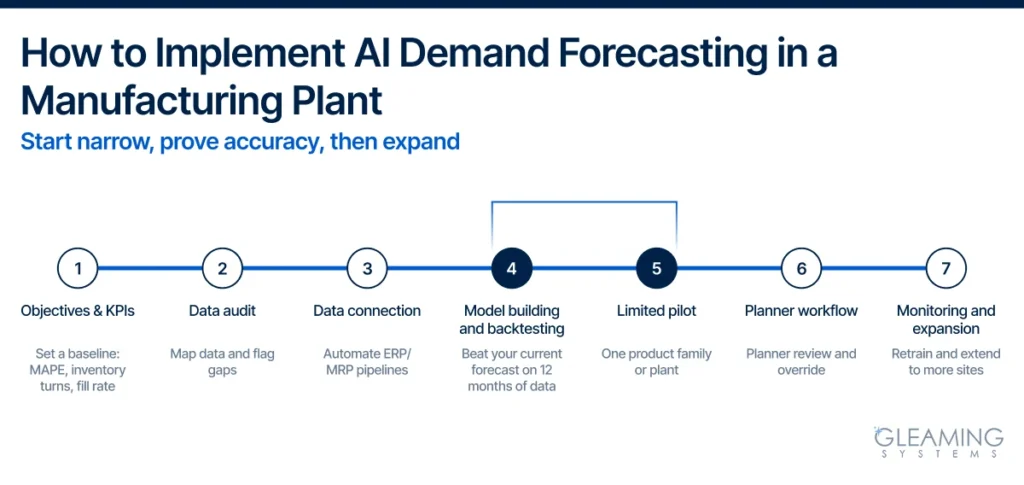
Start narrow, prove accuracy, then expand. Projects that try to forecast every SKU at once tend to stall before planners trust the output.
1. Objectives and KPIs
Pick the problem you’re solving first: excess inventory, stockouts, or schedule churn. Record your current MAPE, inventory turns, and fill rate so you have a baseline to beat.
2. Data Audit
Map where order, inventory, and production data lives. Flag gaps and inconsistencies before any modeling starts.
3. Data Connections
Build pipelines from the ERP/MRP and other sources. Automate them early, because manual exports break the moment someone goes on vacation.
4. Model Building and Backtesting
Train candidate models and test them against the last 12 months of actual demand. If the model can’t beat your current forecast on past data, it isn’t ready for the plant.
5. Limited Pilot
Run live forecasts for one product family or one plant across several planning cycles. Compare results against the existing method.
6. Planner Workflow
Put forecasts where planners already work, including S&OP reviews, and let them override. Track those overrides, because they show where the model needs improvement and where planners know something the data doesn’t.
7. Monitoring and Expansion
Watch accuracy monthly and retrain as demand patterns change. Then extend to more product lines and sites.
What to Look for in an AI Demand Forecasting Development Partner
The right Ohio manufacturing technology partner understands plant data as well as machine learning. Use this checklist when comparing manufacturing demand forecasting solutions:
- Manufacturing experience: Ask how they’ve handled BOMs, production constraints, and messy ERP data.
- Machine learning depth: They should explain why they chose a model, in plain language.
- ERP/MRP integration: Look for a track record with your specific system.
- Data engineering: Pipelines matter as much as the model.
- Security: Ask about access controls, data residency, and how they handle production data.
- Cloud infrastructure: The setup should scale without surprise costs.
- Monitoring and retraining: Models drift. Ask what happens after month three.
- Clear scope and pricing: Phased deliverables with defined outcomes.
- Post-launch support: Ongoing software maintenance and support keeps forecasts accurate as your business changes.
As an AI software development company serving Ohio manufacturers, Gleaming Systems has handled both sides of this problem: production data and forecasting.
Manufacturing Operations Project
An industrial finishing manufacturer needed one clear view of work moving through its plant. We connected shop floor tracking, a mobile app for staff, issue reporting, and billing into a single operations system.
- 75% better real-time visibility into production across departments
- 60% shorter average production delays once the new system went live
- 80% of floor issues now reported and closed faster
Retail Forecasting Project
For a retail business, we built a model that predicts what will sell and ties staffing plans to those predictions. All of it runs on one shared source of sales and customer data.
The lesson carries straight into manufacturing: forecasts only pay off when the data behind them is connected and the people using them trust the numbers. Closing that gap is the focus of our work as an AI development company. You can also see how we work from first conversation to launch.
Frequently Asked Questions
How accurate is AI demand forecasting?
Forecast accuracy depends on your data and product mix. Measure it with MAPE against your current method, since industry benchmarks rarely reflect your SKUs. High-volume, stable SKUs usually see the biggest gains, while sparse, intermittent parts improve less.
How much historical data do we need?
It depends on how stable your demand is. Steady, repeat products need less history, while new products can borrow patterns from similar items until they build their own record.
Can AI forecasting integrate with Epicor, Plex, or SAP Business One?
Yes. Integration can run through APIs, direct database connections, or scheduled exports. Older or heavily customized versions sometimes need a middleware layer.
How long does implementation take?
A focused pilot often runs a few months, from data audit to live forecasts. Full rollout depends on the number of sites, integrations, and how quickly planners adopt the new workflow.
Do we need an in-house data science team?
No. You need a planner who knows the business, an IT contact for system access, and a partner who builds and maintains the models. Planners do need training on reading confidence ranges and handling exceptions.
Can AI forecast demand at the SKU level?
Yes. Forecasts can run by SKU, location, and week, then roll up so plant and product-family totals stay consistent.
Start Planning Your AI Demand Forecasting Solution
Start with your data before you look at any software. Identify the one forecasting problem costing you the most, check what your ERP can share, and decide whether a pilot or a broader build fits your situation. Ohio plants that do this groundwork make faster, safer decisions about AI demand forecasting in manufacturing.
If you’d like a second opinion, the Gleaming Systems team can review your data, ERP setup, and forecasting needs, then outline a realistic scope and budget. Get in touch to start the conversation.

Team Gleaming Systems
Team Gleaming Systems is a group of tech experts specializing in software, web, and mobile app development. We create innovative, scalable solutions to help businesses succeed in the digital world. Stay tuned for expert insights and industry trends!