

Key Takeaways:
- AI development cost in Ohio typically range from $5,000 for a basic proof of concept to $500,000+ for an enterprise platform.
- Most projects take around 2 months to 12+ months, depending on scope.
- Data readiness and system integrations move a quote more than the AI model itself.
- Cloud, API, monitoring, and maintenance costs continue after launch and belong in your budget from day one.
- A focused pilot is the cheapest way to test an AI idea before a bigger commitment.
Whether you want predictive maintenance on a production line, AI-assisted documentation for clinical staff, or shipment planning for a distribution operation, one question comes up before any AI project starts: what will this actually cost?
Getting a straight answer is harder than it should be. Ask three AI development companies to quote the same project, and you may get three numbers that barely resemble each other. That’s rarely padding. AI projects differ widely in data needs, integrations, and risk, and each team fills the gaps in a brief with its own assumptions.
This guide puts real numbers on AI development cost in Ohio. You’ll see planning ranges by project tier and solution type, the factors that push a quote up or down, the costs that appear after launch, and what to check before you sign. The ranges come from our own project scoping rather than survey averages, so use them as a planning baseline, not a fixed price list.
How Much Does AI Development Cost in Ohio? (Quick Overview)
If you’re wondering how much it costs to build an AI system, most Ohio businesses should budget between $5,000 and $500,000+, with timelines from around 2 months to more than a year. Here’s how that breaks down:
| Project Tier | Typical Cost | Typical Timeline | What You Usually Get |
|---|---|---|---|
| Pilot/Proof of Concept | $5,000 to $25,000 | Around 2 months | One use case, limited data, a test of whether the idea works |
| AI MVP | $25,000 to $80,000 | 2 to 4 months | A working product with core AI features, basic integrations, and real users |
| Mid-Complexity Solution | $80,000 to $200,000 | 4 to 8 months | Multiple AI features, deeper integrations, security and compliance work |
| Enterprise AI Platform | $200,000 to $500,000+ | 8 to 12+ months | Several connected AI systems, large data pipelines, MLOps, and scale |
The jump between tiers rarely comes from “more AI.” It comes from more data sources, more integrations, more users, and stricter security requirements. A chatbot and an enterprise analytics platform can use similar underlying models and still sit hundreds of thousands of dollars apart in AI software development cost.
AI Development Cost by Solution Type
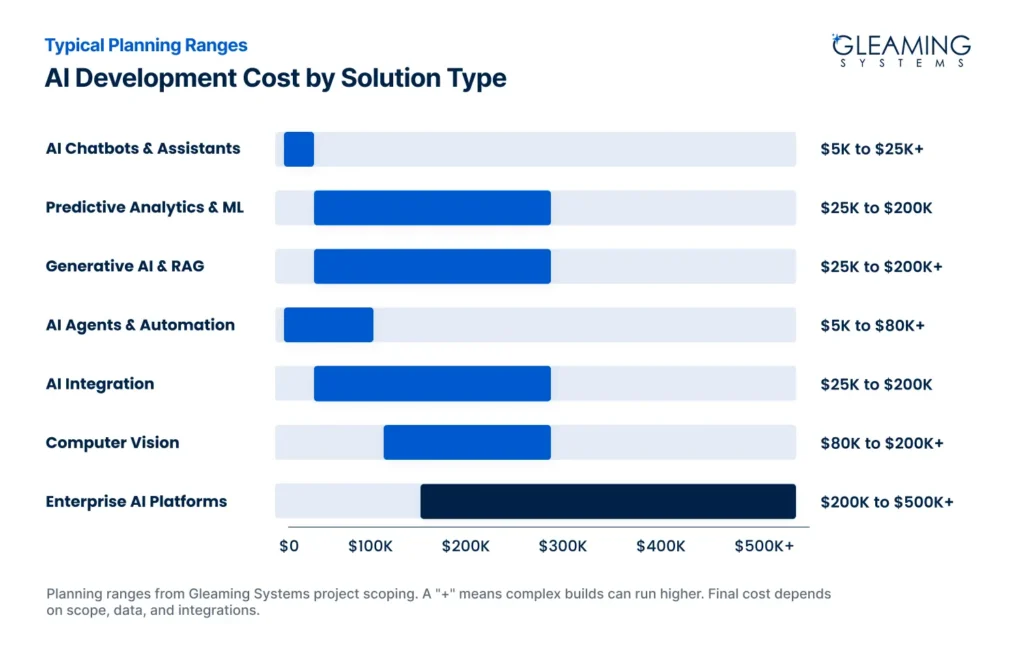
The type of AI you build sets your starting point. The ranges below map to the tiers above.
AI Chatbots and Virtual Assistants
A chatbot that answers questions from your documents or FAQs usually fits the pilot range of $5,000 to $25,000. AI chatbot development cost rises once the bot needs live data from your CRM or order system, a handoff to human staff, or support across web and messaging channels. Each of these is separate engineering work, not a setting you switch on.
Generative AI and RAG Applications
Knowledge assistants, drafting tools, and copilots built on large language models typically cost $25,000 to $200,000. The model is rarely the expensive part of generative AI development cost. The work goes into retrieval-augmented generation (RAG): preparing your documents, controlling what the model can access, and testing answers for accuracy.
You can see this in practice in our GenAI course builder case study. If you’re weighing who should build a retrieval-based system, our roundup of RAG development companies is a useful next read.
AI Agents and Workflow Automation
AI agents take action on your behalf: routing tickets, updating records, processing documents, or triggering approvals across several tools. AI agent development cost usually runs $25,000 to $200,000+.
A single-workflow agent is manageable. An agent working across your ERP, inbox, and CRM needs guardrails, audit logs, and human review points, and those take real time to build. If agents are on your roadmap, our look at agentic AI development companies is worth a read.
AI Integration Into Existing Software
The AI integration cost for existing software depends mostly on the software. Modern platforms with clean APIs often keep projects in the pilot-to-MVP range, while legacy systems with undocumented data structures push costs higher. That second scenario is common among Ohio’s established distributors and manufacturers. Our guides on AI integration and AI integration for logistics companies cover the planning side.
Predictive Analytics and Machine Learning
Predictive maintenance, sales forecasting, churn prediction, and risk scoring models typically run $25,000 to $200,000. These models learn from your historical data, so cost tracks data volume and quality. A manufacturer in Dayton or Akron with years of clean sensor data will move faster and spend less than one starting from spreadsheets.
Computer Vision Systems
Quality inspection, safety monitoring, and visual document processing generally land between $80,000 and $200,000+. Image collection, labeling, hardware choices, and testing under real lighting and camera angles drive most of the cost. A pilot focused on one defect type can come in far lower.
Enterprise AI Platforms
When several AI capabilities share one data foundation, enterprise AI development cost moves into the $200,000 to $500,000+ range.
We saw this firsthand with a retail client that came to us with three broad goals: better stock planning, more relevant marketing, and smoother store operations. Meeting them took eight connected systems, from a single shared view of customer data to predictive models, product suggestions, staff scheduling support, and a customer-facing assistant.
The shared data layer carried the most weight. Nearly every other system relied on it, which is why enterprise budgets often put so much into data work before any visible AI feature ships.
Key Factors That Affect AI Development Cost
Two projects with the same goal can end up with very different quotes. These five factors usually explain the gap.
Data Readiness
This is the most underestimated cost in AI projects. If your data sits in disconnected systems, uses inconsistent formats, or lacks labels, part of the budget goes to cleaning and structuring it before model work begins. A development partner who quotes without asking about your data is guessing.
Scope and Feature Count
Every new capability means more engineering. One social listening product we built started with three core pieces: a chatbot, automatic summaries of long text, and sentiment analysis for public posts. As the product took shape, the feature list grew to include voice commands, support for several languages, instant alerts, and a reporting view for the client’s team.
Each addition made the product more useful, and each carried its own cost. Decide early what belongs in version one.
Custom Build vs. Off-the-Shelf Tools
Off-the-shelf AI tools are cheap to start but charge per seat or usage, and they rarely fit unusual workflows. Fully custom models have the highest custom AI solution cost, but they give you control over data, behavior, and IP.
For custom AI software development in Ohio, most businesses land in between: pre-trained models adapted with their own data and business logic through custom software development. Fine-tuning or full model training is worth paying for only when a pre-trained model can’t reach the accuracy you need.
System Integrations
Every connection to an ERP, CRM, EHR, or warehouse system adds development, error handling, and testing. Cloud platforms with documented APIs are cheaper to connect than older on-premise software.
Security and Compliance
For Ohio healthcare organizations, AI that touches patient data must meet HIPAA requirements. That means access controls, audit logs, encryption, and business associate agreements with cloud and AI providers. The same applies when adding AI to tools like custom patient portals for Ohio healthcare. Build compliance into the first estimate, because retrofitting it later costs more.
Building an In-House AI Team vs. Hiring an Ohio AI Development Partner
For most Ohio businesses running a first or second AI project, a development partner costs less and ships sooner. An in-house team makes sense once AI is central to your product and there’s steady work to keep a full team busy.
The math explains why, especially if you plan to hire AI developers in Ohio full-time. Software developers in the U.S. earned a median of about $136,000 a year as of the May 2025 BLS wage estimates, and engineers with machine learning experience often command more. Pay also varies within the state, with larger tech markets like Columbus and Cincinnati typically paying more than smaller metros.
A lean AI team usually needs four core roles:
- ML engineer: builds, tests, and tunes the models.
- Data engineer: prepares data and keeps pipelines running.
- Backend developer: connects the AI to your products and systems.
- MLOps engineer: handles deployment, monitoring, and retraining.
Four hires near that median would top $500,000 a year in salary alone, before benefits, recruiting, and tools. Hiring can also take months, since Ohio employers compete with remote-first companies nationwide for the same people.
| Factor | In-House AI Team | Ohio AI Development Partner |
|---|---|---|
| Cost Structure | Fixed salaries and benefits | Project-based or hourly |
| Time to Start | Months of hiring | Weeks |
| Skill Coverage | Limited to who you hire | AI, data, and software skills on one team |
| Best Fit | Ongoing, core AI products | Pilots, MVPs, and defined projects |
When businesses compare in-house vs. outsourced AI development cost, this is the real tradeoff: fixed payroll versus paying only for the work a project needs. If you’re comparing AI developer hourly rates in Ohio, ours range from $25 to $49. Working with an AI/ML integration company in Columbus, Ohio, also keeps collaboration in your time zone, which matters when you’re reviewing model outputs every week.
Hidden and Ongoing Costs of AI Development
An AI system keeps costing money after launch. Ongoing AI maintenance costs and usage fees are the line items most often missing from early budgets.
Cloud Inference and Hosting
Every prediction or generated response uses compute. Your bill grows with users and request volume. Self-hosted models add GPU and server costs, while API-based models shift that spend to per-request fees.
API Token Costs
LLM applications pay per token. A chatbot used by ten employees costs very little, while the same chatbot open to thousands of customers can produce a meaningful monthly bill. Ask for a usage-based estimate before launch.
Monitoring and Retraining
Models drift as products, customers, and data change. Prediction models need periodic retraining, and LLM applications need re-evaluation when providers update their models. This MLOps work never fully stops.
Maintenance and Support
Bug fixes, security patches, and dependency updates continue for the life of the system. Set aside a recurring budget for software maintenance and support from the start.
How Ohio Businesses Can Reduce AI Development Costs
The biggest savings come from sequencing the work well and avoiding spend that doesn’t prove value.
Start With a Pilot
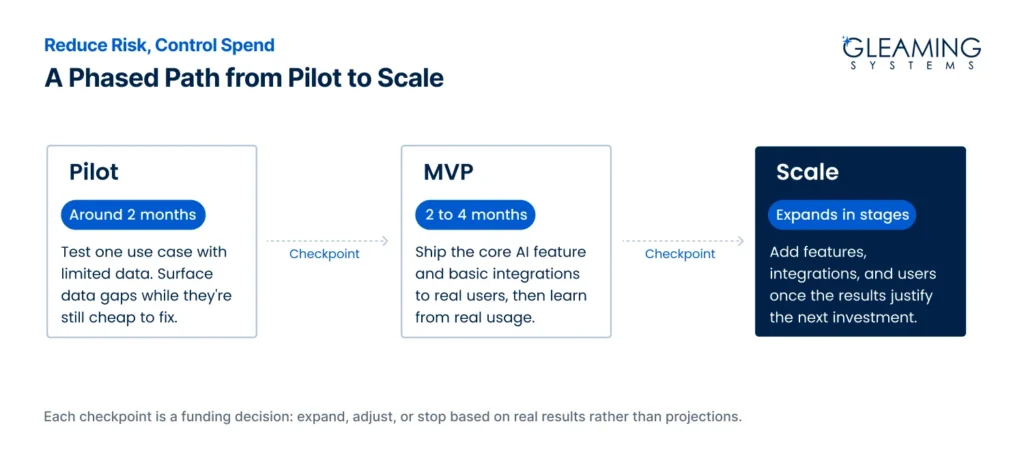
A two-month pilot on one use case tells you whether the idea works. It also exposes data problems while they’re still cheap to fix. If the pilot proves out, the move to an MVP follows the same path as any software product development effort: a narrow feature set, real users, and fast feedback.
Use Pre-Trained Models First
Building on existing models and APIs skips months of training work and gets a working version in front of users sooner. Save custom training for the parts of the product that clearly need it.
Clean Your Data Early
Before development starts, assign someone internally to consolidate key data sources and document what each field means. That groundwork shortens one of the most expensive phases of many projects.
Choose a Measurable Problem
Pick a use case tied to a number, such as hours saved, downtime cut, or error rates reduced. It makes ROI easy to prove and the next budget easier to approve.
Build in Phases
Fund the project in stages with clear checkpoints. You can stop, adjust, or expand based on real results rather than projections.
What to Look for in an Ohio AI Development Partner
When comparing AI development services in Ohio, a low quote means little if the project stalls halfway. Before signing, check for:
- Proof of AI work: case studies, demos, or products you can actually see.
- A discovery phase: a proper look at your data and systems before a fixed estimate.
- Transparent pricing: costs broken down by phase and feature, not one lump sum.
- Clear data security answers: where your data lives, who can access it, and how compliance is handled.
- Ownership terms: you should own the code, trained models, and data after launch.
- Post-launch support: a defined plan for monitoring, fixes, and updates.
As an Ohio-based AI development company, we run our own projects this way: discovery first, phased delivery, and pricing tied to a clear scope. Our How We Work page lays out the full process.
Frequently Asked Questions
These are the questions Ohio business leaders ask most often when planning an AI budget.
How much does it cost to build an AI app in Ohio?
AI app development cost usually falls between $25,000 and $200,000. Simple proofs of concept start around $5,000, and enterprise platforms can exceed $500,000. If your app also needs standard mobile or web features, our guide to app development cost in Ohio covers that side of the budget.
How much does an AI chatbot cost for a business?
A document-based chatbot typically costs $5,000 to $25,000 to build. Chatbots connected to live business systems or built for complex, multi-step conversations cost more, and usage-based API fees continue monthly after launch.
What does an AI MVP cost?
An AI MVP usually costs $25,000 to $80,000 and takes 2 to 4 months. It should include the core AI feature, basic integrations, and enough polish for real users. For help comparing options, see our guide to choosing a top MVP development company in Ohio.
How long does AI development take?
Plan for around 2 months for a pilot, 2 to 4 months for an MVP, 4 to 8 months for a mid-complexity solution, and 8 to 12+ months for an enterprise platform. Data preparation and integration work cause most delays.
Is AI development worth it for small businesses?
It is when the use case is narrow and measurable. A small business doesn’t need an enterprise platform. A focused pilot on one costly, repetitive task can show value within months on a modest budget.
Final Note
AI development cost in Ohio depends far more on your data, integrations, and scope than on the AI itself. Start with one measurable problem, test it with a pilot, and expand only when the results justify it. That approach protects your budget and gives you real numbers for the next decision.
If you’d like a second opinion on a quote you’ve received, or a scoped estimate for your own project, you can contact us, and our team will walk through it with you.

Team Gleaming Systems
Team Gleaming Systems is a group of tech experts specializing in software, web, and mobile app development. We create innovative, scalable solutions to help businesses succeed in the digital world. Stay tuned for expert insights and industry trends!