
A supplier pushes a delivery back nine days. Your planner finds out when the receiving dock stays empty. By then, the schedule is wrong, an expedite fee is coming, and a customer order is at risk.
AI supply chain management is built to catch that chain reaction early. And the need is growing: in the National Association of Manufacturers’ Q1 2026 Manufacturers’ Outlook Survey, 63.3% of respondents said supply chain risk and volatility had increased over the past year.
AI won’t stop a supplier from shipping late. It reads the signals spread across your ERP, supplier records and shipment updates, then warns the right people while there’s still time to act.
What Is AI Supply Chain Management in Manufacturing?
AI supply chain management uses machine learning, predictive analytics and related methods to predict problems, detect exceptions and recommend actions across planning, sourcing, production and delivery. It learns from your own data: order history, inventory records, supplier lead times, production schedules and outside signals such as freight delays.
Traditional planning applies fixed rules, like “reorder at 500 units.” AI estimates what’s likely to happen next and adjusts as conditions change.
| Area | Traditional planning | AI-supported planning |
|---|---|---|
| Forecasting | Averages plus manual edits | Learns patterns and external signals |
| Safety stock | Fixed, reviewed yearly | Recalculated as demand and lead times shift |
| Supplier performance | Quarterly scorecards | Monitored continuously |
| Exceptions | Found late by planners | Detected and ranked by impact |
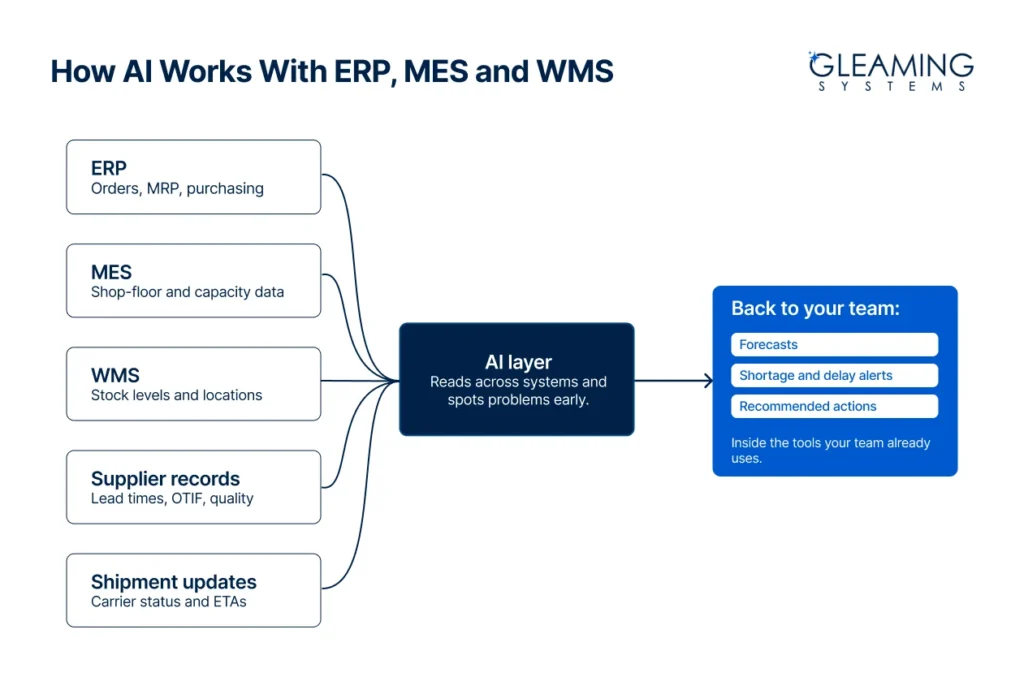
How AI Works With ERP, MES and WMS
AI doesn’t replace your core systems. Your ERP still runs MRP and purchasing, your MES tracks the shop floor, and your WMS manages stock. The AI layer reads from all three and sends recommendations back into the tools your team already uses. Manufacturers with a modern ERP or custom WMS development in place usually see results faster, because their data is already organized.
AI Supply Chain Management Use Cases for Manufacturers
The best use cases share one trait: a decision your team makes again and again, using data you already have, where a wrong call costs real money.
Demand Forecasting and Demand Sensing
Forecasts built on last year’s averages fall apart when a major customer changes its ordering pattern. AI combines order history, seasonality and external signals into forecasts that update as orders arrive. Demand sensing corrects the next few weeks of the plan from short-term signals, which matters most for food and beverage producers working with short shelf lives. We cover models and data sources in depth in our guide to AI demand forecasting in manufacturing.
KPI to watch: forecast accuracy
Inventory Optimization and Material Shortage Prediction
Most plants carry too much of what they don’t need and too little of what they do. AI recalculates safety stock for each item based on real demand and lead-time variability. It also projects material coverage against the production plan, so a shortage of a $3 connector that would stop an electronics assembly line shows up weeks ahead. If inventory still lives in spreadsheets, moving to cloud-based inventory systems first gives AI cleaner data.
KPIs to watch: inventory turnover, stockout frequency
Supplier Risk Monitoring and Procurement Planning
A quarterly scorecard tells you who failed last quarter, not who’s about to fail next month. AI tracks on-time delivery, lead-time drift, quality rejections and price changes continuously. It flags slipping suppliers before a late part reaches an automotive line and points procurement to qualified alternates.
KPIs to watch: supplier OTIF rate, lead-time variance
Production and Supply Planning
This is where supply chain decisions meet the shop floor. AI connects forecasts, material availability, machine capacity and labor to suggest schedules your plant can actually run. In metal fabrication, where one late casting can idle several downstream operations, that connected view matters more than a perfect forecast. It also gives S&OP meetings numbers to debate instead of opinions.
KPIs to watch: schedule adherence, on-time delivery
Logistics and Shipment Exceptions
Inbound delays are often visible days early, buried in carrier updates. AI predicts arrival times, compares them with when material is needed, and alerts only on delays that affect production or customers. The same techniques used in AI integration for logistics companies apply directly to a manufacturer’s inbound freight.
KPIs to watch: shortage-related downtime, expedite costs
Agentic AI
Agentic AI supply chain management goes beyond recommendations. An AI agent can investigate an exception, pull data from several systems, draft a revised purchase order and carry out approved actions.
Keep it supervised: agents do the legwork, and people approve anything that commits money or changes a customer promise. For help evaluating partners, see our roundup of agentic AI development companies.
Example: One Delayed Resin Shipment
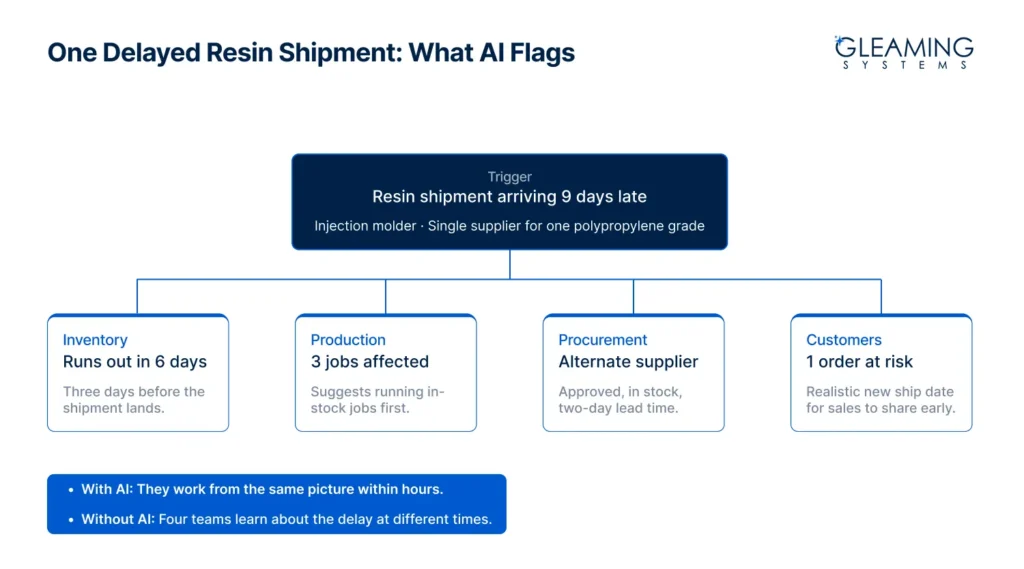
An injection molder relies on one supplier for a specific polypropylene grade. The carrier update shows the shipment will arrive nine days late. Here’s what AI flags:
- Inventory: The plant runs out in six days, three days before the shipment lands.
- Production: Three jobs use that grade, so it suggests running in-stock jobs first.
- Procurement: An approved alternate supplier has stock and a two-day lead time.
- Customers: One order is still at risk, with a realistic new ship date for sales to share early.
Without AI, four teams learn about the delay at different times. With it, they work from the same picture within hours.
Benefits of AI Supply Chain Management
The core benefit is earlier, better-informed decisions. Everything else follows.
McKinsey reported that early adopters of AI-enabled supply chain management improved logistics costs by 15%, inventory levels by 35% and service levels by 65% compared with slower-moving competitors (McKinsey, 2021). Since the study is several years old, treat those numbers as a sign of what’s possible rather than a forecast for your plant.
Key AI supply chain management benefits include:
- Cost savings: Less working capital tied up in slow-moving stock and fewer obsolete write-offs.
- Cycle time reduction: Faster exception handling and fewer orders waiting on material.
- Faster disruption response: Problems surface while you still have options.
- Supply chain visibility: Supplier performance trends and inbound delays show up between scorecard reviews.
- Less manual work: Planners stop rebuilding spreadsheets and focus on judgment calls.
| Business objective | KPI |
|---|---|
| Better forecasts | Forecast accuracy |
| Less excess inventory | Inventory turnover |
| Fewer shortages | Stockout frequency |
| Reliable suppliers | Supplier OTIF rate |
| Shorter cycles | Order-to-delivery cycle time |
Set baselines before the project starts. Without one, nobody can prove the benefit later.
AI Supply Chain Management Software vs. Custom Solutions
Buy software when your processes are standard. Build custom when your workflows, data or integrations are what set you apart. Many manufacturers end up with both.
| Factor | Off-the-shelf software | Custom AI solution |
|---|---|---|
| Time to start | Faster for supported workflows | Depends on scope |
| Workflow fit | Standard processes | Built around your plant |
| Integration | Supported connectors only | Built around your systems |
| Maintenance | Handled by the software provider | Needs a support plan |
| Cost structure | Recurring license fees | Upfront build plus support |
When Software Makes Sense
Packaged AI supply chain management software and platforms suit manufacturers with a modern cloud ERP, standard make-to-stock production and one well-defined use case. You start faster, but watch for modules you’ll never use and limits on adjusting the models.
When Custom Makes Sense
Custom AI supply chain management solutions fit when packaged tools force you to change how your plant works.
Typical signs are a legacy or heavily customized ERP, plants on different systems, or high-mix, low-volume production. An AI development company can train models on your data and decision rules. The trade-off: you own the upkeep.
The Hybrid Approach
Many mid-sized manufacturers keep their ERP and add custom AI only where the ERP falls short. A custom software development company typically builds the layer connecting the models to ERP, MES and supplier data. It’s often the most practical route.
How to Implement AI Supply Chain Management in Manufacturing
Start with one problem, prove it with a pilot, then expand. Applying AI everywhere at once is the fastest way to stall.
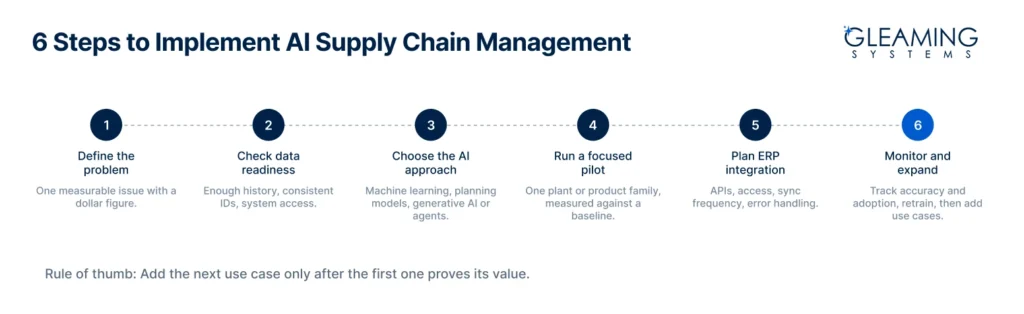
1. Define the Problem
Pick one measurable issue, such as recurring shortages of a critical material. Put a dollar figure on it. That number becomes your business case.
2. Check Data Readiness
You don’t need perfect data. You need enough history, consistent item and supplier IDs, and access to the systems holding them.
3. Choose the AI Approach
Match the method to the problem:
- Machine learning: forecasting demand, lead times and arrivals
- Planning models: scheduling with many constraints
- Generative AI: reading supplier emails and documents
- AI agents: multistep workflows with approvals
4. Run a Focused Pilot
Limit it to one plant or product family. Run AI alongside your current process and compare results against the baseline.
5. Plan ERP Integration
AI supply chain management ERP integration decides whether people use the tool. Settle APIs, read and write access, sync frequency and error handling early. Good AI integration puts recommendations inside the screens planners already use.
6. Monitor and Expand
Models drift as demand and suppliers change. Track accuracy and adoption, and plan for retraining and ongoing software maintenance and support. Add the next use case only after the first proves its value.
Not sure your data is ready? A short review of your systems usually answers that quickly. Book a call to talk it through.
How Much Does AI Supply Chain Management Cost?
There’s no fixed price. Cost depends on scope, the condition of your data and how many systems need to connect.
Think in three scopes:
- Pilot: One use case and light integration, built to prove value.
- One use case in production: Full integration, access controls, monitoring and training.
- Multi-system rollout: Several use cases across plants, with shared data pipelines.
The biggest cost drivers are data preparation, integration with ERP, MES and WMS, model development and validation, security requirements, and ongoing support.
ROI Timeline
The AI supply chain management ROI timeline depends on how costly the problem is, how ready your data is, and how fast planners adopt the tool. A simple formula:
Annual ROI = (annual savings − annual running costs) ÷ implementation cost
As an illustration, cutting average inventory by $400,000 at a 20% carrying cost saves $80,000 a year, before counting avoided expedites.
Common Challenges and How to Overcome Them
Process and people stall more projects than models do. A McKinsey survey found more than 60% of supply chain planning projects ran late or over budget, with poor process design and missing capabilities among the leading causes (McKinsey, 2021).
Inconsistent Data: The same part has three IDs across ERP, MES and the supplier portal. Clean and map only what the first use case needs.
Legacy Systems: Older ERPs often lack modern APIs. A middleware layer can read data without changing the ERP.
Low Planner Trust: Planners quietly override recommendations they don’t understand. Show the reasoning behind each one and use human-in-the-loop approvals.
Limited AI Skills: Few mid-sized manufacturers employ data scientists. Build knowledge transfer into any outside engagement.
Access Control: AI that can change orders needs limits. Set permissions, approval thresholds and audit logs from day one.
How to Choose the Right AI Development Partner
The right partner understands manufacturing as well as AI. Many AI supply chain management companies can build a model. Fewer can run it inside a 15-year-old ERP and win over skeptical planners.
When comparing AI supply chain management services or software companies, look for:
- Fluency in MRP, BOMs, lead times and S&OP
- Proven ERP, MES and WMS integration
- A pilot-first approach with clear success criteria
- Strong security and access controls
- Support and knowledge transfer after launch
Questions to Ask Before Hiring
- How will you assess our data and systems first?
- Which use case would you pilot, and why?
- How will it connect with our ERP and planning workflow?
- How will we measure success?
- What support will it need after launch?
How Gleaming Systems Approaches AI Projects
Gleaming Systems builds custom AI and software for US businesses, from AI model development to ERP integration and long-term support. Projects start with a data and systems review, move to a focused pilot with agreed metrics, and expand once results are proven. You can see how we work from first conversation to ongoing support.
FAQs
What is AI supply chain management?
AI supply chain management uses machine learning to forecast demand, predict shortages, monitor suppliers and recommend actions across planning, sourcing, production and delivery. Recommendations adjust as your data changes instead of relying on fixed rules.
How is AI used in manufacturing supply chains?
Manufacturers use it for demand forecasting, inventory optimization, shortage prediction, supplier monitoring, production planning and shipment exceptions. AI agents can also investigate issues and draft actions for people to approve.
What are the main benefits of AI supply chain management?
More accurate forecasts, lower inventory costs, fewer shortages, shorter cycle times and faster disruption response. Results depend on data quality, the use case chosen and team adoption.
How does AI supply chain management integrate with ERP systems?
Through APIs or data pipelines. AI reads orders, inventory and supplier records, then returns forecasts, alerts or recommendations, ideally within the ERP screens your team works in every day.
How long does implementation take?
It depends on data readiness, scope and integration complexity. A single-use-case pilot moves much faster than a multi-plant rollout, so prove value with one use case first.
How much does AI supply chain management cost?
Cost depends on the number of use cases, data preparation, integrations, model development, security and support. A pilot costs far less than a full rollout.
Should manufacturers buy software or build a custom solution?
Buy if your processes are standard and your ERP is supported. Build if you run a legacy ERP, multiple systems or unique workflows. Many choose a hybrid.
Conclusion
AI supply chain management gives manufacturers an early, shared view of problems while there’s still time to act. Success comes from discipline: pick one costly problem, set a baseline, prove value with a pilot and expand.
Agentic AI leads the AI supply chain management trends of 2026, and Gartner ranks it among the year’s top supply chain technologies. For most mid-sized manufacturers, though, the biggest near-term gains still come from better forecasts, smarter inventory decisions and earlier supplier warnings.
Planning AI for your supply chain? Gleaming Systems can help you assess the use case, integration needs and the right development approach. Book a call to discuss your project.

Team Gleaming Systems
Team Gleaming Systems is a group of tech experts specializing in software, web, and mobile app development. We create innovative, scalable solutions to help businesses succeed in the digital world. Stay tuned for expert insights and industry trends!